My review of Michael Shapiro’s new book on the aborted life of the Continental League, a would be addition to the majors, appears in today’s Los Angeles Times. (I sure picked the right day to run a baseball story in the paper.) “Bottom of the Ninth” is a book that’s absolutely worth your time, though not an easy one, and not without its flaws. Though we all have a tendency to stick our heads in the sand when it comes to the ugly shenanigans that are the business of baseball—we watch baseball because it’s supposed to be entertainment—unless we keep an eye on history’s fine print it’s impossible to hold accountable those who control the game. Those who are ignorant of the past, are condemned to repeat it. Or perhaps we’d be condemned anyway, but a little bit of knowledge doesn’t hurt, especially if it comes in an enjoyable package.
Red Star

The New York-Amsterdam connection has been much in the news of late, and rightly so, as this is the 400th anniversary of Henry Hudson’s Dutch-sponsored voyage of American discovery. An exhibition at the MCNY, a new book on the landscape he found, and any number of events mark the occasion. With all that, it would be easy to overlook a small exhibition on Eugeen Van Mieghem and the Red Star Line at Flanders House. The show documents the relationship between New York and Antwerp, Amsterdam’s rival to the south. In the sixteenth century, when Amsterdam was barely a mark on the map, Antwerp was the cultural and financial capital of Northern Europe, a position it lost to its northern neighbor. In the late nineteenth and early twentieth centuries, however, Antwerp was a major port of embarkation for the deluge of humanity fleeing Europe for America. Some two million emigrants departed Antwerp on Red Star Line ships, the preponderance coming to New York. Eugeen Mieghem, an Antwerp native, captured the lives of those harried travelers in his tender paintings and pastels. The beautiful Red Star Line posters featured in the show are also a treat.
Moscow’s Jewish Museum

I’ll skip commentary on the grim events at the Holocaust Museum in Washington in favor of more sanguine news in the Jewish museum world. Earlier this week plans were released for the new Jewish museum in Moscow, to be placed in Konstantin Melnikov’s landmark Balhmetvsky bus depot. The renovation is by the German firm Graft. The exterior will remain essentially untouched. Inside, a scrolling blobby insertion—”intervention,” to use the architectural term of art—will connect the two floors of the structure, and serve various programmatic needs. I use the term scrolling, but I’m not sure the architects had anything so literal in mind, which makes it a nice change of pace from the architectural parlante of other Jewish museums, to say nothing of Daniel Libeskind’s abstracted Hebrew letter forms in Berlin and elsewhere. How well or poorly such amoebic shapes will relate to Melnikov’s open space, or serve their functions, is another story. We’ll see.
All in the Family

My cousin Barbara Schaefer is having a show of recent work at Shop Art, on Bergen Street in Brooklyn. (Convenient!) Barbara is walking sunshine, and her pictures—big tactile abstractions, with caligraphic skeins of paint—channel her personality. I’ve always thought there was something Rubensian about them in their energy and handling of the painted surface. Also, they make me smile.
House in the Hills
We spent this past weekend at the beautiful weekend home of the Woo family, a masterwork of modernist architecture sequestered high in the rolling Vermont hills. Kyu Sung Woo, the paterfamilias, designed it himself, and his limpid vision and great attention to detail show everywhere. (The project may be familiar; it was recently featured in the Wall Street Journal.) The main house is comprised of a pair of light-filled, two-story bar structures, hinged at the middle. The volumes and geometries are asymetric but have a natural sense of harmony to them. Horizontal and vertical bands in a variety of materials (blond-wood floors, green clapboard siding panels, corrugated metal) give interiors and exteriors visual energy and direct the eye into the landscape. It’s all controlled and executed with immense care and polish. A few pictures:
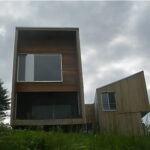
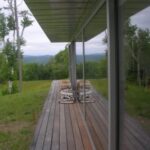
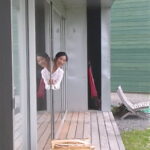

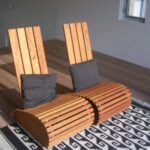
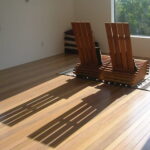
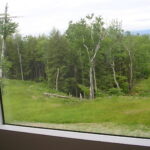

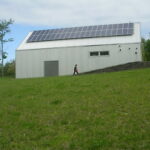

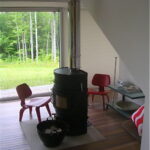


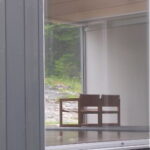

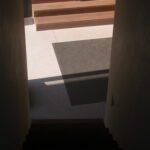
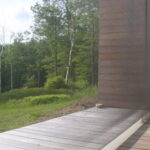

Tormented Youth

Next week the MET will put on display Michelangelo’s “Torment of Saint Anthony,” reputedly the artist’s first painting. It’s a rare chance to see the picture, which was restored by the museum’s crack conservation department, before it heads off to its home at the Kimbell, in Ft. Worth. You have to love how flat-out bezonkers it is, understandable when you learn that it was (supposedly) painted when the artist was all of 12 to 13 years old. Contemporary sources tell us the boy-genius studied the wares at the local fish market to aid him in the realism of his monsters. The small boat at the bottom of the picture, sailing off apparently unaware of the drama above, is an especially nice touch.
Bowery on the Beach?


Has Leigh Bowery, said to have died more than a decade ago, been hiding out on the Coney Island boardwalk sporting a mullet all along? Peter Arkle took the photo at left on Sunday. Lucien Freud’s classic portrait of Bowery on the right. You make the call. But wIth all due respect, when it comes to fleshy naked derrieres, I’ll stick with the master:
BEA Report: 10 Fall Books (+1) for Your Library

It has been a grim year for publishing, which accounts for the unusually restrained mood this past weekend at Book Expo America, the industry’s annual trade show. Attendance was down 17 percent compared to 2007, the last time it was held in NY. Among the absentees were big guns like Doubleday, Knopf, and FSG, the art-book house Phaidon, and indy fave McSweeney’s. “Whether it makes sense for us to be here is an ongoing question,” one publisher told me. I wonder about the future of the show. With so few booksellers left to sell to, it’s hard to see how the costs publishers lavish on their booths justify themselves. Which is why so many simply punted, opting only for basement meeting rooms and not major public displays. I didn’t hang around long: trudging the aisles is an enervating task even in the best of years. I did manage to see a few old colleagues, however, and to snag a few catalogs and advance reading copies. From what I saw, and it was an entirely random sampling, here are ten books (plus one) I’ll be reading this fall, in no particular order:
Continue reading BEA Report: 10 Fall Books (+1) for Your Library
Urban Camouflage

The Magritte Museum opens next week on the Place Royale, in Brussels. For the past several months, as it was prepared for its unveiling, the building was cloaked by this brilliant trompe-l’oeil construction wall, very much in the spirit of the artist. (The house in the middle is Magritte’s home and studio, a few miles away on rue Esseghem.) I hope this painting will be on display inside, to double the pleasure:

It would seem there is a certain proclivity among Belgian-based artists for trompe l’oeil effects on their architecture. In the early seventeenth century, Peter Paul Rubens actually painted a series of faked sculptures around the courtyard of his house.

But that was just the beginning of his visual gamesmanship. On the garden facade of his studio, a building he designed himself, he painted a fake loggia, and then to heighten the apparent “realism” of this scene, painted a canvas that appeared to be hanging out to dry in front of it. (If you look carefully, you can see this composition on the far right of the second story in the blurry image above.)
Architectural camouflage, of course, is most often used in wartime, to ward off enemy aircraft. I can’t help but think of Jon Stewart’s running accusation that Dick Cheney had the Vice President’s residence obscured on Google Earth. It would be nice to develop some more inventive applications of these types of effects. Could they be used to test-drive projects in development? What if, one day, New York was dummied up to look like Paris? Or flipped around so the West Side was on the East Side? The mind boggles. Time for coffee.
Memorial Day

It’s Memorial Day in America, so let’s talk for a moment about memorials. The other day I came across the image above, from an unveiling on a road outside of Detroit. Even acknowledging the centrality of the highway in American life, this seems a bit crass to me. (New Yorkers might think of the Ari Halberstam Memorial Access Ramp to the Brooklyn Bridge, a tribute that makes a bit more sense, as Halberstam was murdered on the bridge.) The naming above was tied to the opening of the Holocaust Memorial Center in Farmington Hills, MI.

This is the museum, a work of architecture parlante by Neumann Smith & Associates. Here’s a bit of the firm’s description of the building: “The gray and blue striping on the second story reminds visitors of the camp clothing Holocaust prisoners were forced to wear. The cables criss-crossing the exterior brick represent concentration camp fencing. Even the shaggy greenery around the perimeter is reminiscent of the meadow grass that flourished near the camps. All of this uncomfortable imagery is deliberate to convey the great destructive force of intolerance.”
Do we really need buildings like this to educate? We have films and artifacts to teach the specifics—I think a showing of Shoah is enough to permanently instill the horror of the camps on any visitor.

The absurdity of the Detroit memorial museum only reinforces the manifold virtues of Peter Eisenman’s Monument to the Murdered Jews of Europe, in Berlin. This seems to me everything that a memorial should be; physically and emotionally powerful, but not trite. Eisenman is the most cerebral of architects, and his gridded, Cartesian thinking here is still evident. But it is as much from the gut and the heart as from the head, a combination of humors that suits. If only we could have something so deceptively simple and powerful for Ground Zero. It’s a vast improvement over what we’re getting, to say nothing of this.
Meanwhile, in about an hour, a parade of fire trucks and antique cars will file through the quaint Berkshire town where I find myself this holiday weekend. I expect a fine turnout, and can’t imagine a nicer way to honor local veterans.