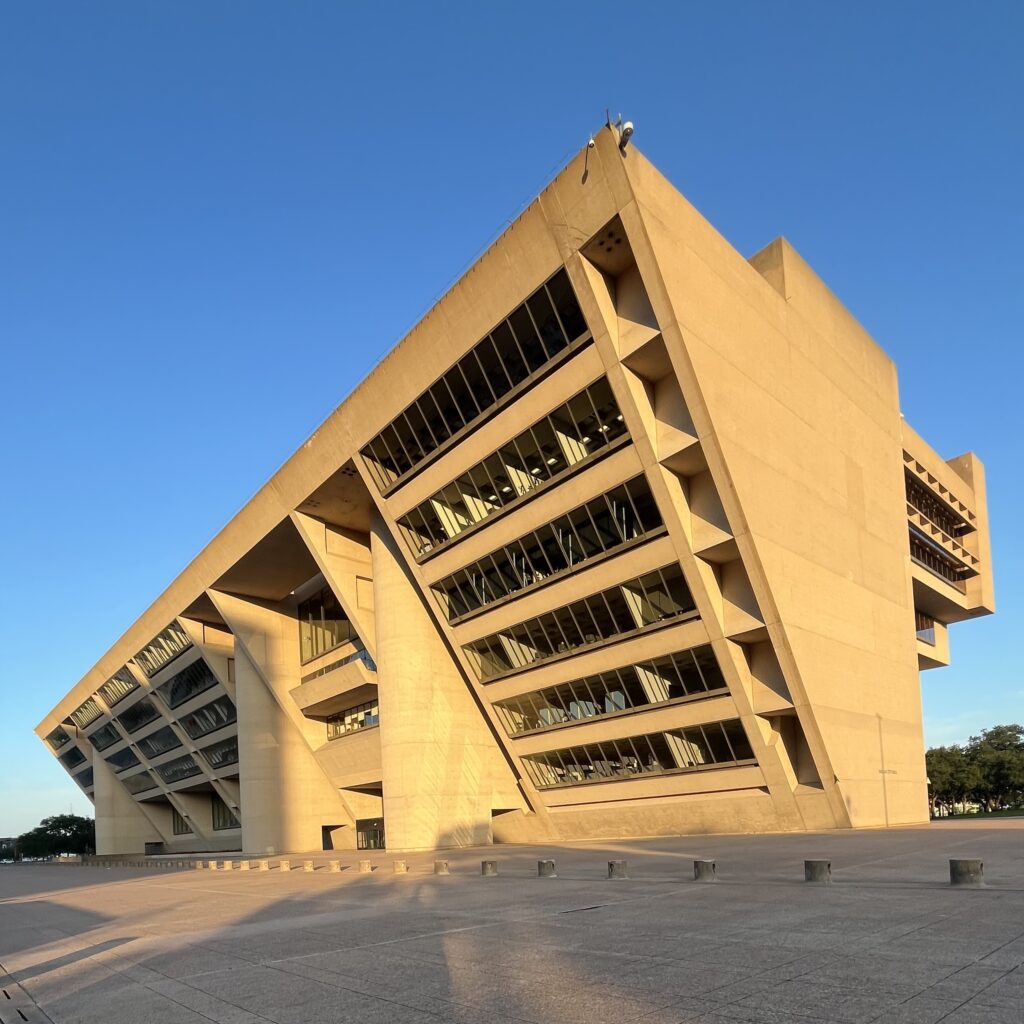
Please join me in the fight to save I.M. Pei’s iconic Dallas City Hall from the wrecking ball, a prospect now under consideration due to a massive deferred maintenance bill and pressure from the development community to replace it with a new sports arena. In my estimation, demolition of this masterwork — Ada Louise Huxtable called it “breathtaking” — would stand as the most significant loss of a public building since Penn Station was torn down in the 1960s. As I write in the Dallas Morning News:
“Of all the irresponsible, ill-conceived, short-sighted, counter-productive, cynical, philistine and downright dumb ideas I’ve heard in my time writing about Dallas, the prospect of razing City Hall stands alone. Demolishing architect I.M. Pei’s iconic building would be an act of epic mismanagement indefensible on aesthetic, environmental, financial or moral grounds.”
Amen!
I cannot believe this is where we are as a City or Society. To remove a sculptural element and building that represents Dallas in its most iconic state with another sports center or what ever they think we need is misguided and poor planning.
appreciate the passion that preservation advocates have for Dallas City Hall and for I.M. Pei’s legacy. However, I believe preserving this building would be a costly mistake.
While City Hall may be architecturally significant to some, many Dallas residents see it as an aging brutalist structure that is neither particularly welcoming nor beautiful. Architectural significance alone is not enough justification for committing hundreds of millions of taxpayer dollars to a renovation.
Dallas is fortunate to already possess several outstanding I.M. Pei contributions, including Fountain Place and the Morton H. Meyerson Symphony Center. Preserving City Hall is not the same as preserving Pei’s legacy in Dallas; that legacy is already secure.
More importantly, the city must consider opportunity cost. Downtown Dallas faces significant challenges, and commercial real estate values have declined substantially. This presents an opportunity, not a problem. Rather than pouring enormous sums into a 1970s government building with persistent maintenance and operational issues, the city could acquire or develop modern office space at a fraction of the long-term cost. In investment terms, this is an opportunity to buy the dip.
Taxpayer dollars are finite. Every dollar spent preserving an architecturally controversial building is a dollar that cannot be spent on public safety, infrastructure, parks, housing, streets, or other priorities that directly improve quality of life for Dallas residents.
The central question should not be whether City Hall is historically important. It should be whether spending hundreds of millions of dollars on this particular building represents the best value for Dallas taxpayers. I do not believe it does.
Respectfully,
A Dallas taxpayer