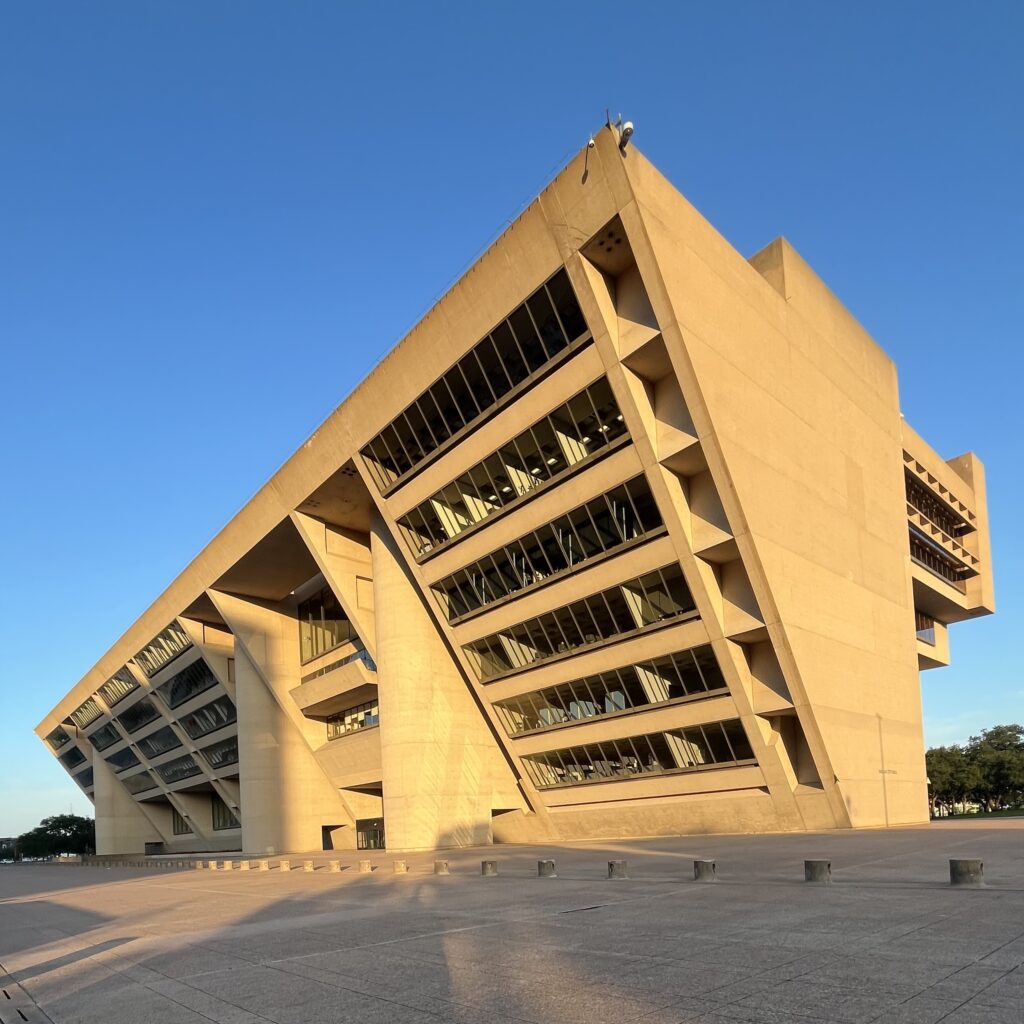
Please join me in the fight to save I.M. Pei’s iconic Dallas City Hall from the wrecking ball, a prospect now under consideration due to a massive deferred maintenance bill and pressure from the development community to replace it with a new sports arena. In my estimation, demolition of this masterwork — Ada Louise Huxtable called it “breathtaking” — would stand as the most significant loss of a public building since Penn Station was torn down in the 1960s. As I write in the Dallas Morning News:
“Of all the irresponsible, ill-conceived, short-sighted, counter-productive, cynical, philistine and downright dumb ideas I’ve heard in my time writing about Dallas, the prospect of razing City Hall stands alone. Demolishing architect I.M. Pei’s iconic building would be an act of epic mismanagement indefensible on aesthetic, environmental, financial or moral grounds.”
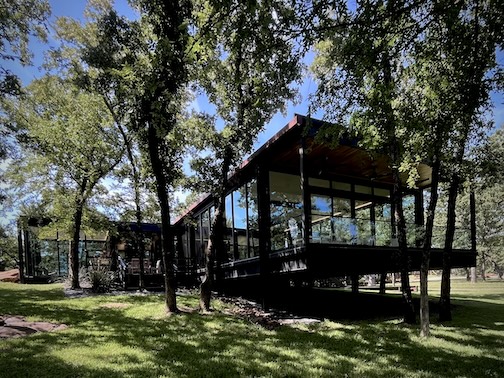
Up in the north Dallas exurbs, sculptor George Tobolowsky has done something that will surely drive architectural purists batty: he has smushed together Mies’s Farnsworth House and Philip Johnson’s Glass House, and somehow doing this while using metal recycled from RedBird Mall. Amazingly, it works. My story on it is here. Another recent feature looks at Pratt Box and Henerson’s St. Stephen United Methodist Church, one of the most avant-garde works of American ecclesiastical architecture of its era (1962), which somehow found its way to suburban Mesquite. It’s what you get when you combine Le Corbusier’s Ronchamp chapel with the adobe architecture of New Mexico. Wild. Other recent work: The foolishness of Donald Trump’s executive order on architecture; a bad plan for Philip Johnson’s Comerica Tower; what a Texas Flood memorial should be; Dallas continually getting in its own way; how to make a safer downtown; the latest plans for the Dallas Convention Center; DFW’s plans for a modular new terminal; Some advice for the new Nasher director; a step forward for Dallas planning (say what?!); the good and the bad at the remade Alamo; the new Medal of Honor Museum; the endless dickering over plans for Thanks-Giving Square; crap movies about architecture; a handsome home for LGBTQIA seniors; and why it’s about time to landmark Dallas City Hall.
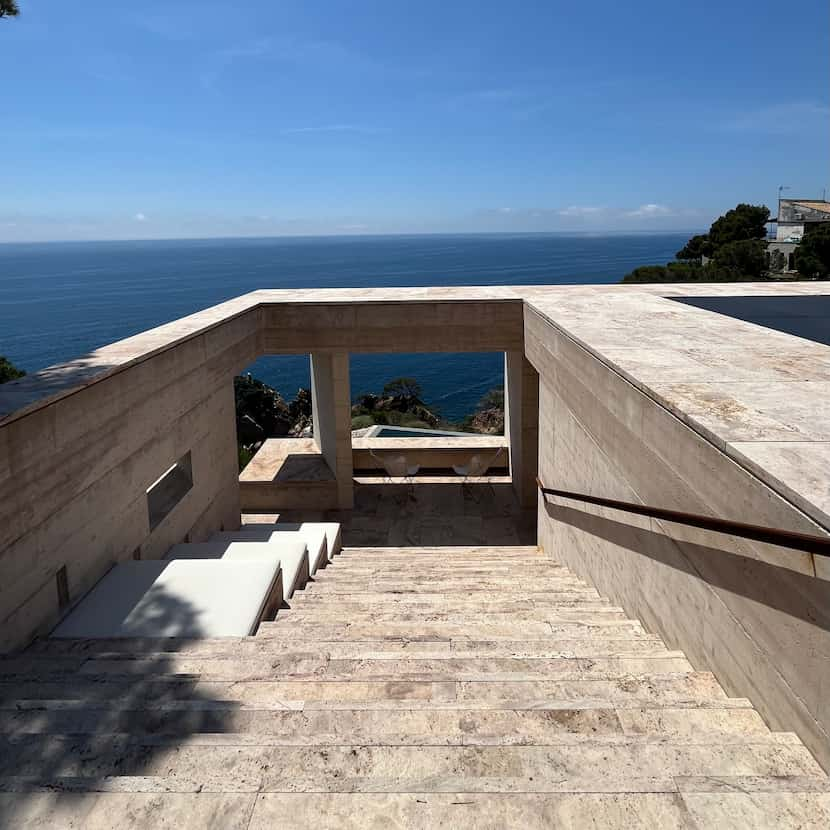
Earlier this summer, I traveled to Spain to visit the work and spend time with the architects Fuensanta Nieto and Enrique Sobejano, who won the commission to “reimagine” the Dallas Museum of Art. I was deeply impressed with both the architects and their work, a I write in a feature for the Dallas Morning News. (The image above is their weekend home on Spain’s Costa Brava.) Some other recent stories: A history of the Nasher Sculpture Center (part of my series on the essential buildings of Dallas). A column on why the bleacher stair trend has to end. A call for a new architecture school in Dallas. A look at the impact on downtown of a new convention center and a potential new basketball arena/casino development. And an explanation of why Dallas housing is “bananas.”
Dealey Plaza doesn’t work. The gateway to downtown Dallas where John F. Kennedy was assassinated is a dangerous mess that fails its critical functions as a site for civic memory and essential transportation corridor. A new plan, developed in collaboration with Stoss Landscape Urbanism, MPdL Studio, and Delineator Landscape, would rectify these flaws, and finally bring a dignified connection to adjacent Martyr’s Park, dedicated to victim’s of lynching in Dallas. Among its key elements would be the closure of Elm Street to traffic, the lighting of the Triple Underpass, placing memorial pools at the points of assassination, the creation of a memorial overlook and promenade linking Dealey Plaza to Martyr’s Park, and the creation of a multi-modal boulevard leading to the Trinity. The plan would maintain the historic integrity of Dealey Plaza, touching only the spaces at its fringes, such that it will appear virtually unchanged since 1963. You can hear me chatting about it here and here.
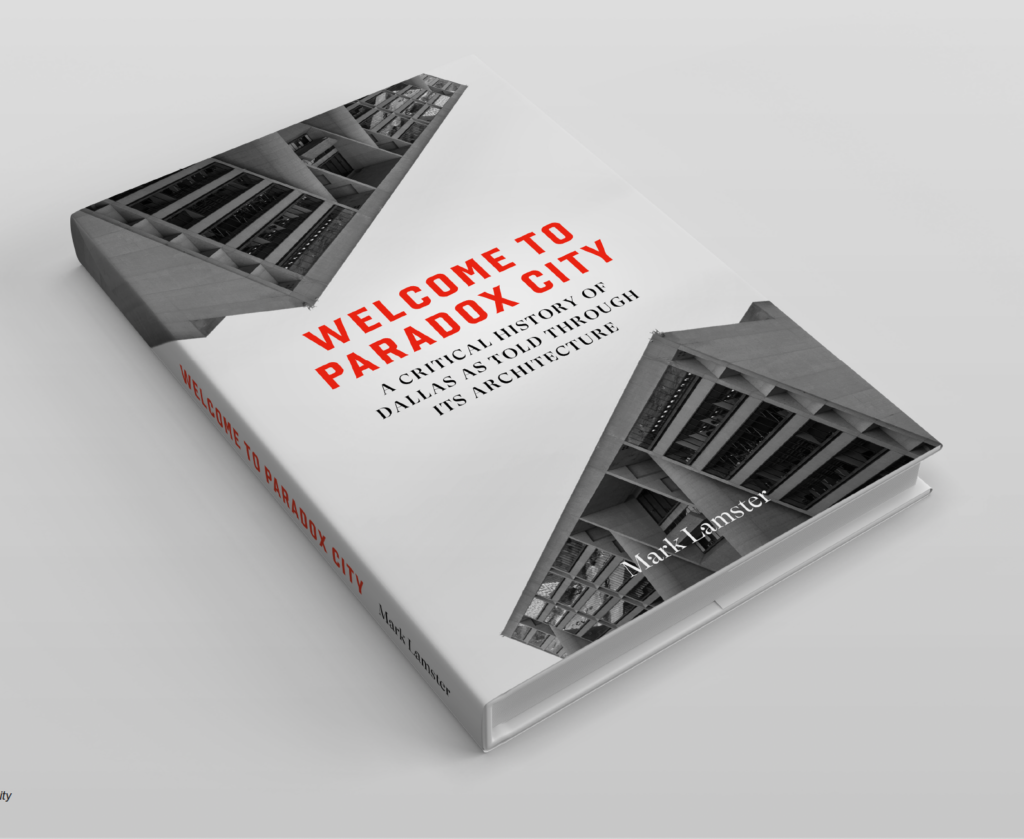
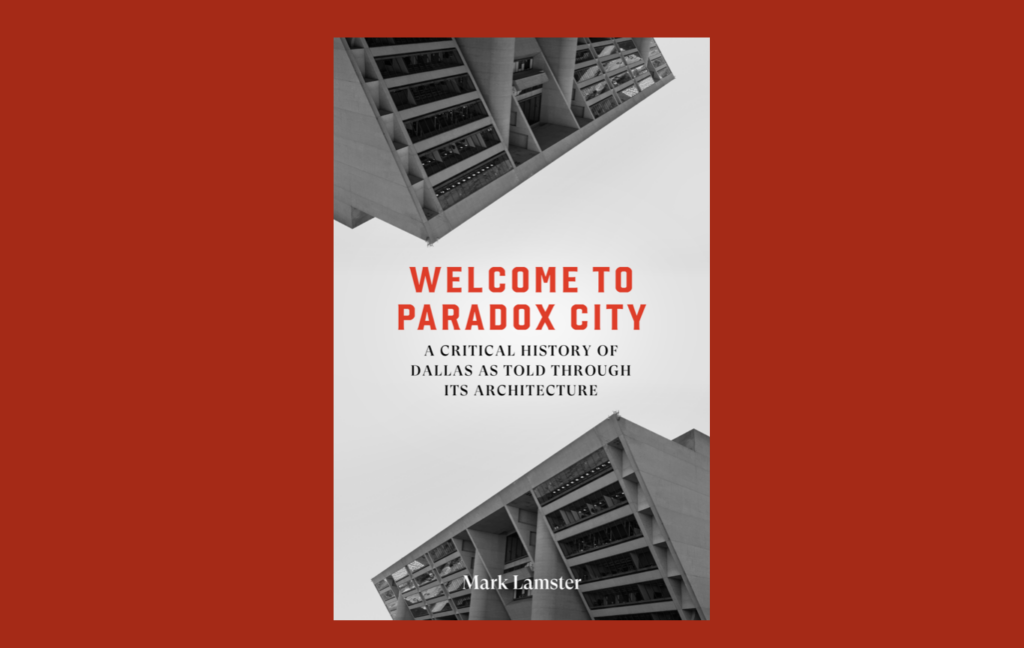
Some happy news: I’m working on a new book, a cultural history of Dallas as told through its architecture. It will be published by the wonderful Dallas-based non-profit Deep Vellum, and is being serialized in the Dallas Morning News. The first installment, on the ante-bellum mansion Millermore, is already live. (Thanks to Allison V. Smith for the wonderful photos.) You can look forward to future pieces on the Adolphus, City Hall, and….well…you’ll just have to wait.
I should also note here that Kevin Lippert the founding publisher of Princeton Architectural Press, and a mentor and dear friend, passed away last month after a decades long battle with brain cancer. (The picture above is Kevin at Expo 2000 in Hanover, a trip we took following the Frankfurt Book Fair that year.) He was an immensely influential figure in the field of architecture, but also in my own life. I wrote a bit about what he meant to me and to the world, at the design site Common Edge. A terrible, terrible loss.
In 1872, an emancipated slave named Henry Critz Hines founded the Fredman’s town of Joppa (pronounced Jop-ee) between the tracks of what is no the Union Pacific Railroad and the flood-prone wetlands of the Trinity River in what is now southern Dallas. In the near century and a half since that time, the city has abused, terrorized, neglected, and otherwise exploited that community. Today, it is perhaps the most polluted neighborhood in Dallas, with a life-expectance more than ten years shorter than more affluent portions of the city. A food desert, it is isolated from the city, accessible only by automobile since its only pedestrian connection to the outside world was severed two years ago, without replacement. The story of this historic and tight-knit community, and its fight for services and recognition, is told in this special report in the Dallas Morning News. It is a story I have been reporting for several years, and with extraordinary photographs by my colleague Lynda Gonzalez.
And now for something completely different. In the early 1970s, the avant-garde collective Ant Farm, best known for the Cadillac Ranch outside of Amarillo, build a lake house shaped like a giant penis for a Houston arts patron. Playboy shot it, and Woody Allen wanted to use it in Sleeper. Today, it’s a decaying relic, but when it was built it was a futuristic vision of what architecture could be. I think you’ll find its story surprisingly moving. Check it out.